

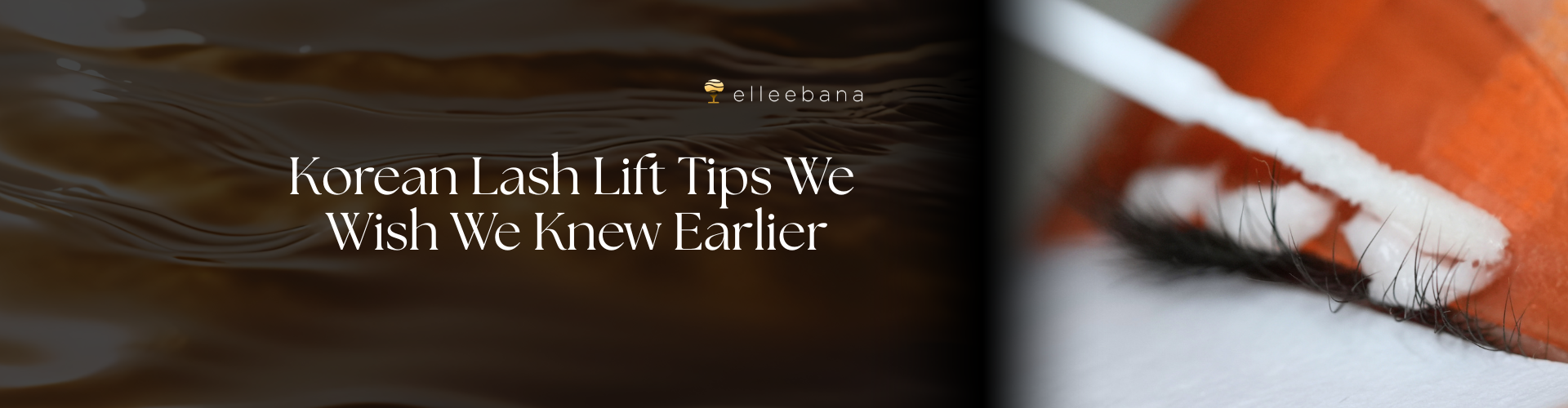
Korean lash lifting has changed the way many artists approach stubborn, downward-growing and resistant lashes. By softening the lashes while they are stretched upwards on a flat shield, the technique can create a strong lift from the base while giving the artist more control over lash direction.
But like any new technique, there are a few things that become much easier once you understand the little details.
From viscosity control and processing to shield sizing and lash baths, these are some of the Korean lash lift tips we wish we knew earlier.
1. More viscosity powder does not always mean more control
When you’re working with thick or resistant lashes, it can be tempting to keep adding viscosity powder until your Step 1 becomes very thick.
But thicker isn’t always better.
Adding too much viscosity controller can dilute the lotion and slow the movement of the active ingredients through the lash, potentially increasing processing time. With Elleemix Powder, for example, Elleebana recommends not exceeding a 50/50 ratio.
Instead, focus on creating a smooth, workable consistency and making sure each lash has an even coating of your thickened Step 1.
And if those stubborn lashes simply don’t want to stay against the flat shield? Don’t keep adding powder just to make them stick.
Use your cling wrap to gently hold them in position while they process.
Remember, Step 1 is about softening the lashes, not perfecting the final wrap.
Once those bonds have softened and the lashes are ready to move, you’ll have much more control when positioning them for Step 2.
2. Your processing environment matters
If you’ve ever noticed your lash lifts taking longer during winter, you’re probably not imagining it.
Temperature can influence how your products behave, particularly when working with cysteamine-based systems. In a colder treatment room, a gentle heat source can help support more consistent processing.
Cling wrap can provide some warmth while also keeping the lashes against the flat shield. Depending on your training and product protocol, a suitable warming eye mask or controlled heat lamp may also be useful during colder months. Elleebana’s Korean lash lift guidance also recommends brow wrap or gentle heat during processing.
But heat should never replace checking the lashes.
Set your timers, stay close to your client and regularly perform your Flex and Set checks. Processing times are a guide. The lashes themselves tell you when they are ready.
For Step 1, you’re looking for that softened, pliable response where the lash bends easily into a V-shape rather than resisting or springing straight back.
3. Consider adding a Step 1.5
One of our favourite additions when performing a Korean-inspired lash lift with BRIK & PEARL® is LASH LIFE™ Volume Filler.
BRIK & PEARL® is another professional system that can be used for approved modern Korean-inspired lash lift techniques. Its Step 1, Bond Flex™, uses a hybrid dual-reduction system combining ATG and Cysteamine HCl, while its controlled viscosity allows it to be adapted across different lifting methods.
LASH LIFE™ Volume Filler can then be incorporated as a Step 1.5, between Bond Flex™ and Bond Lock™.
Why do we love this step?
After removing Step 1, LASH LIFE™ helps:
- remove residual Step 1 product and powder
- support pH rebalancing
- rehydrate and condition the lashes
- prepare the hair for the setting stage
We like to leave LASH LIFE™ on the lashes for approximately 30 seconds before gently removing it with a cotton tip and proceeding with Step 2.
This creates a clean transition between your reduction and setting stages, especially when you’ve been working with thickened lotion during a Korean application. The official BRIK & PEARL® system also identifies LASH LIFE™ as a Step 1.5 treatment that supports residual product removal, pH rebalancing and preparation for Step 2.
4. You may need a bigger rod or shield than you think
There is a reason Korean lash lifts can create such an impressive base lift.
During Step 1, the lashes are stretched upwards against a flat shield while they soften. Once processed and repositioned onto your final rod or shield, they can appear longer than they did during your initial consultation.
Keep this in mind before automatically reaching for your usual size.
If your chosen shield is too small, those newly softened and stretched lashes may sit too far across the face of the shield, increasing your risk of creating too much curl at the tips.
As a general sizing guide, we recommend aiming for the lash tips to reach approximately 80% of the way across the face of the rod or shield.
If you’re sitting between sizes, reassess once Step 1 is complete. Moving up a size can sometimes be the difference between a beautifully lifted result and an over-curled finish.
This is especially useful when working with naturally long lashes or lashes that grow strongly downward.
5. Stop trying to make Step 1 look perfect
This one deserves its own reminder.
Your Step 1 wrap does not need to look like your final Instagram photo.
Korean lifting is about softening the hair while encouraging it upwards from the base. Thick, coarse or criss-crossed lashes may move around, separate or refuse to sit perfectly flat while you’re applying Step 1.
That’s okay.
Make sure your solution is evenly distributed, keep your lashes controlled and use cling wrap where required to hold them against the shield.
Once the lashes have softened, that’s when you can spend the extra time creating clean separation, direction and placement before Step 2.
Trying to create a flawless Step 1 wrap on resistant lashes can add unnecessary time to your treatment without improving the finished result.
6. Yes, you can wash the lashes
We’ll say it again: water itself does not undo a correctly processed lash lift.
Elleebana has addressed the “wet lash myth” directly. A professional lash bath has been part of Elleebana treatment protocols for years, and water contact itself does not reverse a properly processed and neutralised lash lift.
In fact, thoroughly cleansing the lashes can be an important part of finishing the service.
After Step 2, removing remaining lotion residue gives you a clean surface before moving into colouration. After tinting, another thorough rinse helps ensure leftover tint, lotion and other residue are removed from the lashes and eye area.
This matters because you don’t want residual product continuing to sit on chemically treated lashes once its job is complete. Starting your tint stage with clean lashes can also help you achieve more even product contact rather than applying colour over leftover lotion or powder.
Elleebana’s current Korean lash lift procedure includes removing residue with water once processing is complete, while its lash lift aftercare guidance specifically recommends a lash bath to ensure lotions and tint have been properly removed.
A normal lash bath is different from exposing freshly treated lashes to excessive heat, steam or unnecessary friction, so always follow the aftercare recommendations for the system you’re using.
7. Let the lashes tell you when they’re ready
One of the biggest changes you can make to your Korean lash lift services is moving away from relying only on processing charts.
Two clients can have lashes that look similar but respond completely differently once Step 1 is applied.
Your timer is there to guide you. Your Flex Check tells you what is actually happening.
Your viscosity ratio, lash thickness, hair condition, room temperature and use of cling wrap or heat can all influence processing. That’s why checking different areas of the lash line is so important.
Check the inner, middle and outer sections rather than assuming the entire lash line has processed at the same rate.
Once Step 1 is complete, reposition carefully and give Step 2 placement the attention it deserves. This is where you’re setting the direction and shape you’ve worked to create.
Choosing your Korean lash lift system
For artists using Elleebana products, there is now more than one option when performing Korean-inspired techniques.
Elleeplex Profusion uses Cysteamine HCl and can be combined with Elleemix Powder for Korean lash lift applications. Its formulation makes it a popular option for artists who want controlled processing and plenty of time to assess the hair throughout the service.
BRIK & PEARL® can also be used for approved modern Korean-inspired techniques. Bond Flex™ combines ATG and Cysteamine HCl in a hybrid dual-reduction system, with LASH LIFE™ Volume Filler giving artists the option to incorporate the additional Step 1.5 before Bond Lock™.
Whichever system you choose, the same principles remain important: assess the lashes in front of you, control your viscosity, perform your Flex and Set checks and don’t rush your placement.
The little changes make a big difference
Korean lash lifting doesn’t have to mean longer appointments or complicated procedures.
Often, the biggest improvements come from small changes: using less powder, allowing cling wrap to do some of the work, choosing a larger shield, adding a Step 1.5 where appropriate and giving the lashes a proper cleanse before your client leaves.
Most importantly, stop chasing the timer and start reading the lashes.
The more you understand how the hair is responding at each stage, the easier it becomes to adjust your technique from client to client and create consistent, beautifully lifted results.